Company owners
Discuss a transition for a specialist engineering business, with continuity for its people, customers, and practical knowledge.
Discuss a company transition
We acquire, build and develop advanced engineering businesses and technologies. We explore advanced hardware, intelligent systems and AI-enabled engineering across aerospace, robotics and other demanding applications.
Discuss research collaborationThe next chapter
We are evaluating established engineering businesses with deep practical expertise. Our acquisition-first approach centers on permanent ownership: retaining people, equipment, premises, customer relationships, and practical expertise, then developing useful research and products around that foundation.
Current phaseDefining research projects and evaluating acquisitions.
Retain the people, equipment, premises, customer relationships, and practical expertise of an established business under long-term ownership.
Turn recurring requirements into reusable interfaces, validated procedures, and supported software.
Expand capacity when customer demand, technical scope, and committed financing support it.
Find your way in · Exploratory conversations
Discuss a transition for a specialist engineering business, with continuity for its people, customers, and practical knowledge.
Discuss a company transitionIntroduce a research question or scientific capability that could help define a focused, testable project.
Discuss research collaborationExplore technical leadership, operating experience, and long-term company building. Scope and partnership terms remain to be defined.
Explore collaborationResearch & Development
Our current work centers on defining testable research questions, identifying qualified collaborators, and assessing fit with government research programs. Specific projects will be described as their technical scope and collaborators are confirmed.
Our areas of exploration include propulsion, unconventional aircraft, field robotics and spacecraft hardware, plus supporting sensing, controls, materials and power systems. We are also exploring AI for autonomy, perception, simulation, design and testing. These interests remain open as research questions and project needs develop. Researchers, laboratories, partners, facilities, and project rights remain to be confirmed; no research award is represented.
Discuss research collaborationA disciplined process
Frame the questionDefine the research question, its technical scope, and the uncertainty worth investigating.
Find the expertiseIdentify qualified scientific collaborators whose expertise fits the question. Participation remains to be agreed.
Make it testableSpecify the experiment, measurements, and criteria that would support or challenge the research hypothesis.
Define the evidencePlan how results, limitations, and unresolved questions will be recorded and reviewed.
Assess what is neededIdentify the people, equipment, facilities, time, and budget required for a credible experiment.
Agree the termsClarify responsibilities, data access, and intellectual property rights before committing to a project.
Assess program alignmentEvaluate government research programs against the defined question, technical scope, and project readiness.
Keep commitments explicitDistinguish a concept or submission from an award. Work depends on confirmed collaborators, resources, rights, and funding.
Qualified review, defined experiments, and transparent limitations guide the work. Research concepts are not completed results or currently commissioned services.
Long-term campus vision
A long-term vision for bringing engineering, applied research, and company operations together in a proposed Cleveland-area campus.
Explore the campus concept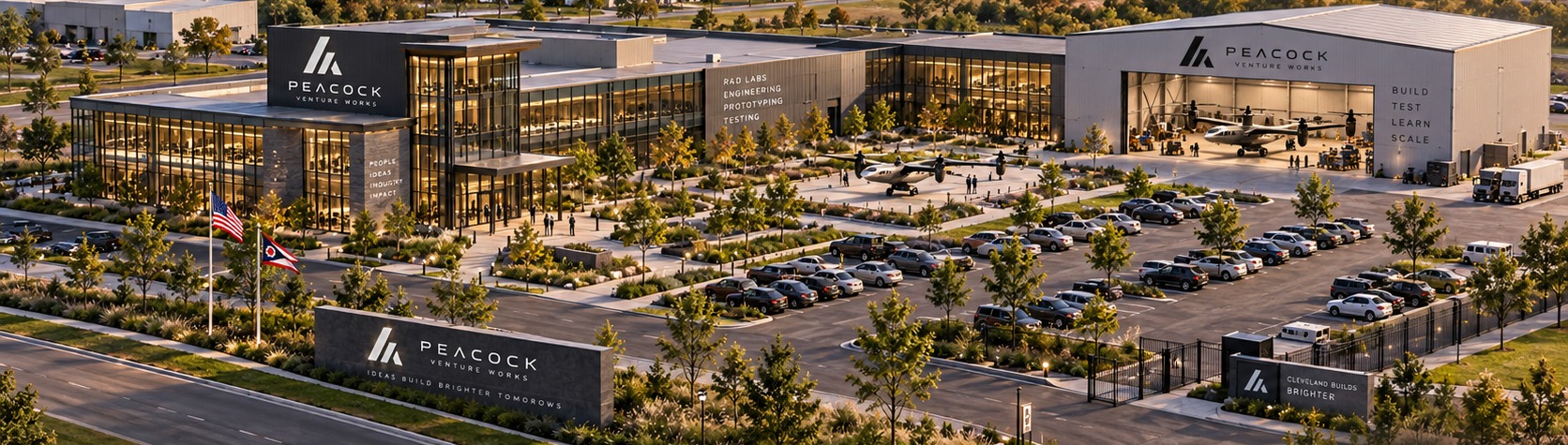
Concept and feasibility stage. Site control, financing, and approvals are not secured. Development is subject to operating demand, design, and those commitments. All campus images are AI-generated concepts; equipment and personnel are illustrative.
Founder-led
Founder, Peacock Venture Works

Cody leads Peacock Venture Works’ company-building and acquisition strategy. His focus is commercial execution, operations, and development partnerships.
His vision for PVW brings established businesses, experienced technical teams, and new technologies together under one long-term home.
Connect with CodyStart a conversation
We welcome a research question, a scientific collaboration, or a company-transition conversation. A short, non-confidential introduction is enough to start.